The 30-Year Paradox: Why Creative ROI Measurement Failed
Jon Evans, Adam Morgan, System1 and Peter Field's, "The Extraordinary Cost of Dull" proves what we've known for decades: dull advertising is expensive.
Really expensive.
The math is stark. In the US alone, brands waste $189 billion annually on dull creative that could achieve the same reach with better work at lower cost. In the UK, it's £13.29 billion. The figures are equally grim everywhere.
And here's what should be uncomfortable: This paper was published in 2023.
Before that, we had the IPA's decades of effectiveness data. Before that, McKinsey, Interbrand, Cannes winners consistently outperformed their peers. We've had proof for 30 years that better creative wins.
Yet nothing changed.
Why not?
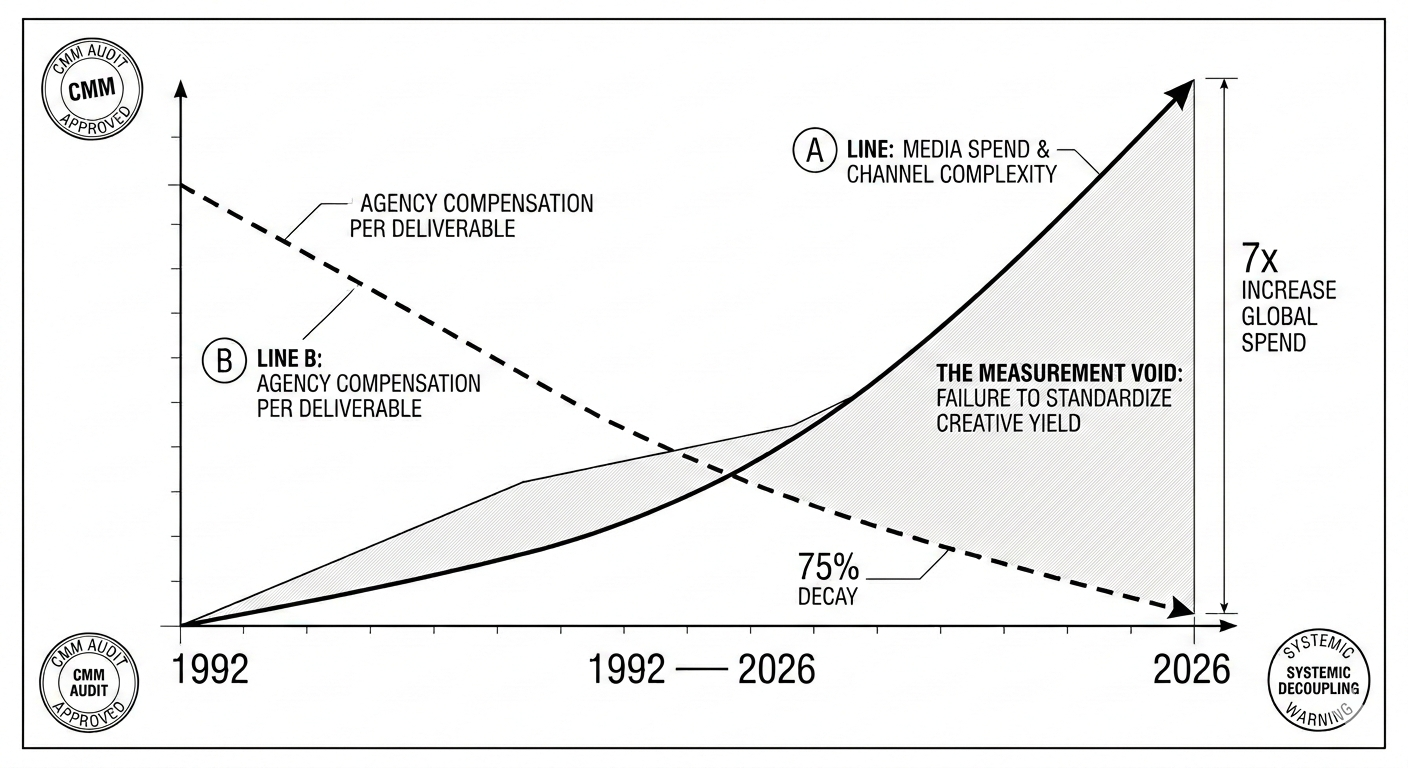
In fact, creative fees have collapsed 75% over the same period. Media spend exploded 7x.
And yet the industry hasn't re-organized. Doesn't now. Won't tomorrow. Unless something fundamental changes.
Why would a $189 billion problem go unaddressed?
The Diagnosis
The answer is uncomfortable: The proof was never financial.
Every insight about creative quality—from System1 Group's emotional resonance data to the IPA's market share correlations to Cannes' decades-spanning track records—spoke in conceptual language. Beautiful language. Compelling language. But not financial language.
CMOs and their teams live in a financial world.
They speak in CPMs, ROI, budget justification, enterprise value.
The Missing Infrastructure: How to Measure Creative Performance Financially
Every other marketing input has financial infrastructure:
Media has CPM models
Technology has unit economics
Data has ROI calculations
Performance marketing has LTV/CAC ratios
Creative?
Still measured in hours spent and deliverables completed.
All those insights about creative effectiveness—from System1 Group's research to decades of IPA case studies—lacked one critical bridge: a scalable, operational framework to measure creative in financial terms, independent of who created it. A method for ongoing guidance, not one-time snapshots. A way to tell teams: 'Here's the multiple you should beat.
And while the data referred to in this article may be from TV ads, the point, insight, observation and truth is the same for every aspect of creative communication today. Whether it's UGC, long-form video for social, print for social, the UX of a website or app, OOH billboards, or physical experiential events. Today it can all be measured, valued and support financial meaning of creative's impact and contribution. Yet it is not.
That's the gap.
Not in the insight.
In the infrastructure.
Prove Creative ROI: The Financial Framework for Creative Effectiveness
What if we could close that gap?
What if we measured creative performance in CPM language? One brand did exactly this. They measured their campaign in an initial audit and found creative performance multiplied their total ad spend by 1.39x and outcomes by 1.95x.
Impressed with the insight, they went deeper—a comprehensive measurement across their full campaign.
The multiplier effect widened: creative performance multiplied their ad spend by 3.13x and outcomes by 4.96x.
That's not margin of error. That's real creative performance differentiation, measured and validated.
What if we could scale this? Build a database across 100s of campaigns showing: Creative at performance level X consistently correlates with Y multiplier impact?
That's what Creative CPM enables: Taking everything we know about creative quality mattering and translating it into measurable, financial terms.
Not new insight.
New operationalization.
The Possibility
Here's what this means.
The industry hasn't failed to recognize that better creative is worth more.
It's failed to build the measurement infrastructure to operationalize that truth.
Jon Evans, Eat Big Fish / Adam Morgan, System1, and Peter Field proved the cost of dull. The IPA proved better work wins. Cannes, McKinsey and Interbrand have proved it for decades. Probably many others as well. But no one developed financial tools to act on those insights at scale.
What if Creative CPM—paired with validated measurement discipline—finally provided that?
Not as revolution. As recognition.
Smart measurement experts, secure agencies, ambitious marketers already understand this. They're watching. Waiting for infrastructure that lets them operate on what they know to be true.
The question isn't whether non-dull creative is worth more. It always has been.
The question is: can we finally make that case financially?
The Next Step
System1 Group, the IPA, McKinsey, Interbrand, and decades of creative effectiveness research opened the door. They proved the problem.
Creative CPM has built the infrastructure to walk through it.
For those already watching—the measurement experts, the agencies that know better, the CMOs tired of making creative arguments without financial proof—this is what you're working on.
If you're ready to measure creative like the asset it actually is, let's chat.